

Holding onto an iPhone for as long as possible sounds like the financially responsible choice. You pay for the device, keep using it, avoid another big purchase, and feel like you are saving money by stretching every extra year out of it. But the core question is whether keeping it longer actually costs more when resale value drops.
The problem is that iPhones do not lose value in a straight, gentle line. They tend to drop hardest around new releases, carrier promotions, battery aging, condition changes, and the point where buyers start seeing the model as old rather than current. That creates a hidden cost most people do not calculate.
SmartphonesPLUS looked at our own numbers to see how this actually plays out. We reviewed 24,949 paid iPhone purchases from June 2021 through July 2026, across 47 models and hundreds of storage and carrier combinations. The pattern held up: most mainstream iPhones lose about half their value by the two-year mark, then give up another big chunk in year three.
The iPhone upgrade cycle is really a resale timing decision. Upgrading every two years may feel expensive because you are buying phones more often, but the trade-in value of your old phone can offset much of the next purchase. Waiting four or five years can feel cheaper in the moment, but your phone may lose so much value that you have less cash to put toward the next one. The main point is that timing the sale can matter more than stretching ownership.
This guide uses that data to break down the math behind early trade-ins, late-lifecycle selling, and the upgrade window where many iPhone owners can keep more value. It focuses on when waiting stops saving money and starts costing more, and shows exactly where that turn happens.
How the iPhone Upgrade Cycle Changes the Math
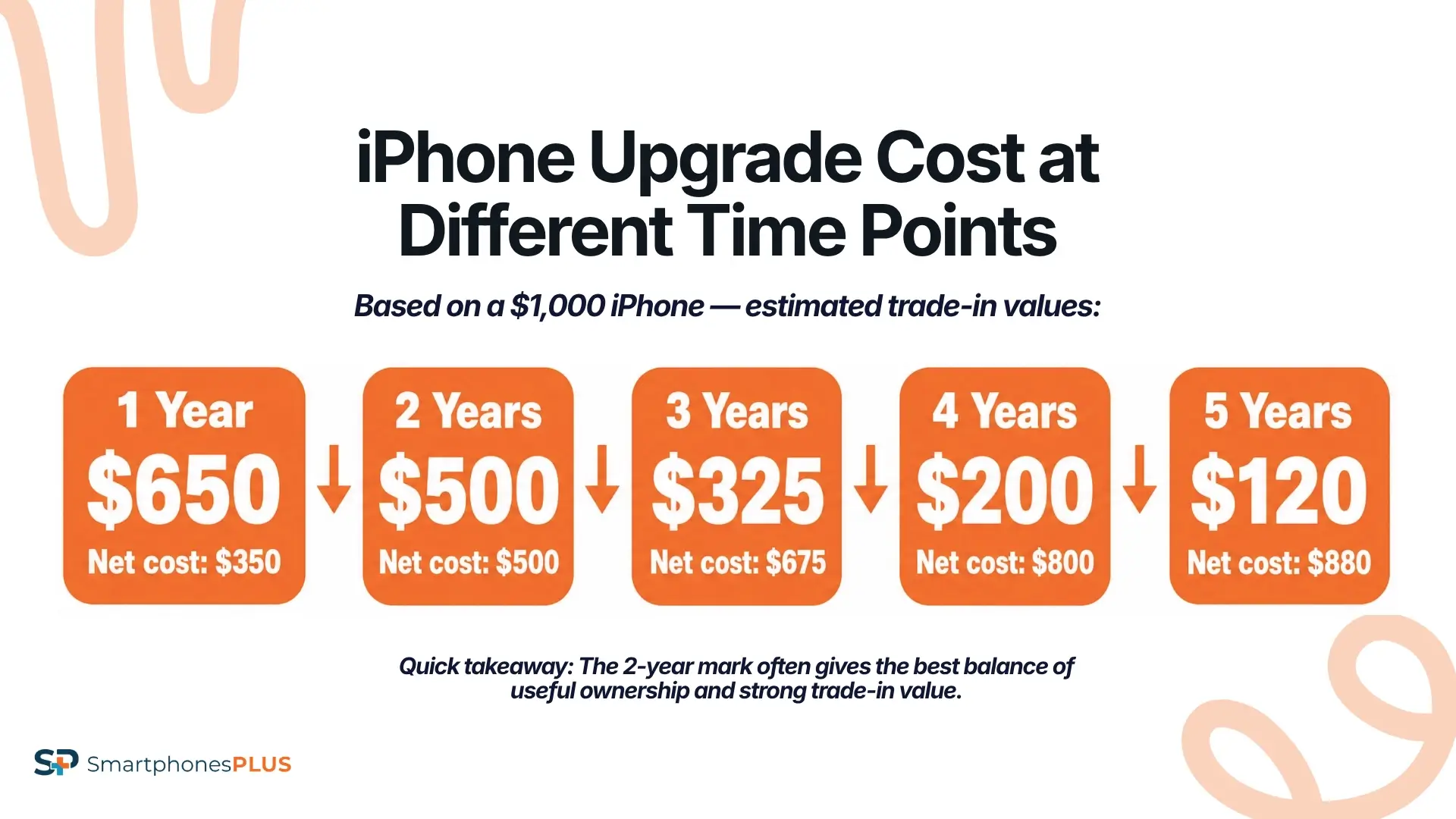
The two-year mark can offer a strong balance between getting useful life from an iPhone and selling while it still holds meaningful value. Your phone usually still has decent resale demand, current software support, and a better shot at a solid trade-in offer.
Waiting longer can still work if your phone stays in great condition, but the financial risk grows as resale demand softens and damage becomes more likely.
Here is what our own data shows for six mainstream and premium models. Each figure measures value relative to a model’s typical price during its first six months on the market, so it reflects the general trend rather than a live trade-in quote.
| Model | Records | Value Retained: 12 Mo. | 24 Mo. | 36 Mo. |
| iPhone 13 | 1,176 | 72.0% | 51.9% | 37.4% |
| iPhone 13 Pro | 335 | 77.0% | 59.3% | 45.7% |
| iPhone 13 Pro Max | 624 | 69.1% | 47.7% | 32.9% |
| iPhone 14 | 426 | 69.7% | 48.6% | 33.9% |
| iPhone 14 Pro | 359 | 75.5% | 56.9% | 43.0% |
| iPhone 14 Plus | 260 | 82.3% | 67.7% | 55.7% |
About this data: These numbers come from SmartphonesPLUS’ own purchase history, covering trade-ins, wholesale deals, and other ways we acquire phones. That mix means the figures show the general trend rather than an exact quote you’d get on our site today. We also adjusted for storage, carrier, and condition so the comparison is apples-to-apples across models.
There is no single upgrade date that works for every model. Our data does show that many mainstream iPhones hold onto roughly half their value at 24 months, then lose another meaningful share by month 36.
The iPhone 13, for example, dropped from 51.9% at two years to 37.4% at three years. That makes year three an important tradeoff between getting more use from the phone and giving up another chunk of its resale value.
Why Waiting Longer Can Feel Cheaper Than It Is
A paid-off iPhone feels free. Once the monthly payments are gone, it is tempting to keep the device until it slows down, cracks, or stops holding a charge.
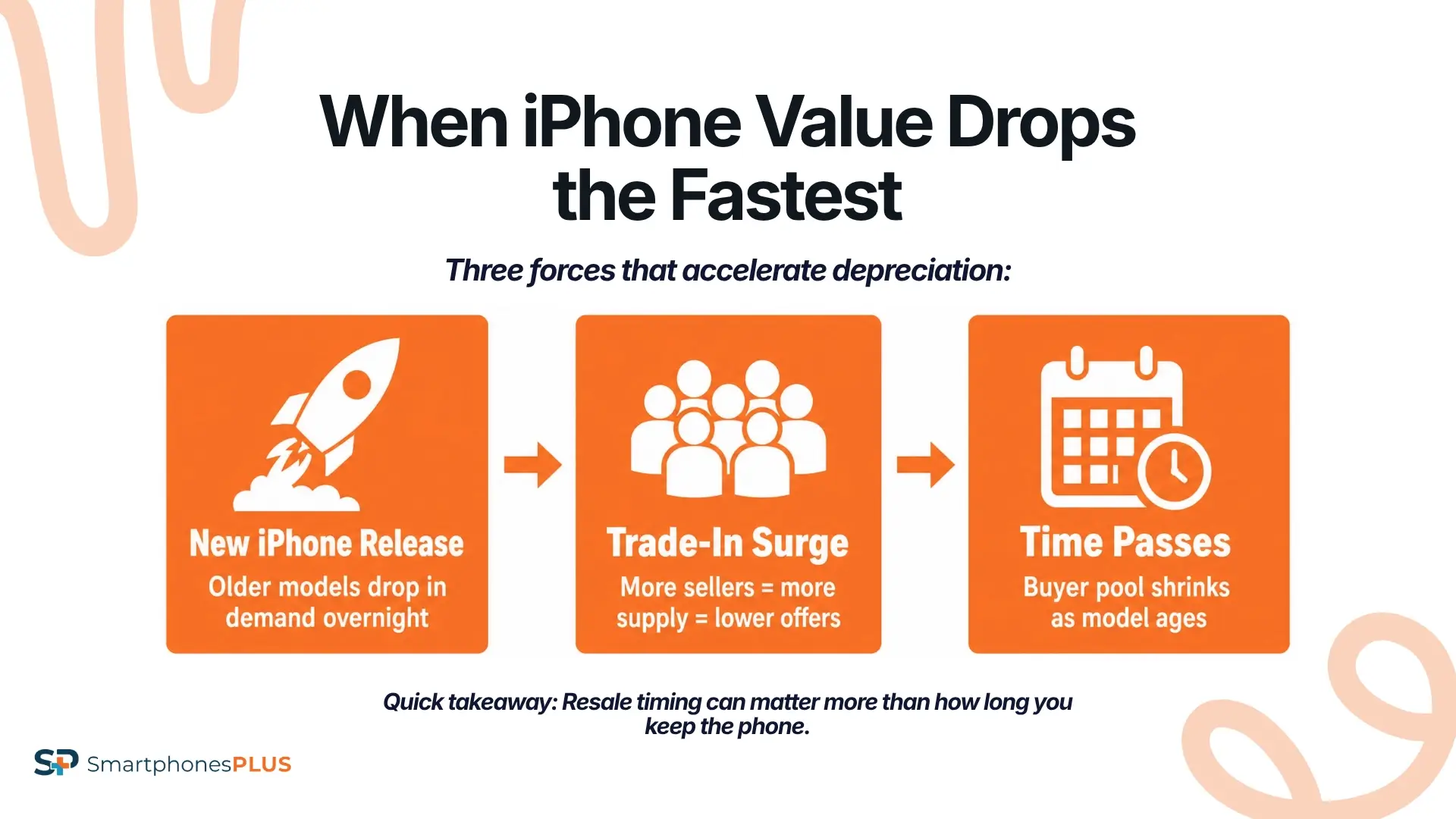
That logic makes sense if the phone stays in excellent condition and still works well for your needs. The resale market does not pause while you keep using it. Every new iPhone release pushes older models further down the ladder. More used devices enter the market after each launch, and buyers have more options.
CIRP found that 61% of iPhone buyers had their previous iPhone for two years or more, which shows that many owners are already stretching their replacement timing. Longer ownership can reduce purchase frequency, but it can also mean trading in after the strongest resale window has passed.
The hidden cost is the value you lose while waiting.
The Depreciation Curve Buyers Forget
Most people think of iPhone value in terms of age. A two-year-old phone is worth more than a four-year-old phone. That part is obvious.
The less obvious part is how sharply the market can move around launch season. A model can hold steady for a while, then fall faster once a newer version arrives and thousands of owners start trading in at the same time.
At SmartphonesPLUS, we see this pattern clearly across our own data too. The chart below tracks four recognizable iPhones from six months after release through their third year on the market, indexed so month six equals 100.
The timing also depends heavily on which model you own. At 24 months, the iPhone 13 held onto 51.9% of its value, the iPhone 14 held 48.6%, the iPhone 14 Plus held 67.7%, and the iPhone 14 Pro held 56.9%. Plus, Pro, and Pro Max labels do not automatically determine how well a phone holds its value. Demand for each specific model matters just as much as its tier.
That pattern creates a simple resale curve. The early years usually preserve the most usable value. Later years may lower your annual cost on paper, but the cash you get back at the end can become much smaller.
If you plan to upgrade anyway, waiting for a perfect moment may cost more than getting a quote while your phone still has stronger demand. The key point is that resale timing can outweigh longer ownership.
The Two-Year Window Often Has the Best Balance
The two-year mark can be the sweet spot because your iPhone is old enough that upgrading feels meaningful but new enough that buyers still want it. Exactly how strong that balance is still depends on the model, as the data above shows.
At that stage, the phone may still have strong performance, current software support, and enough modern features to appeal to the secondhand market. The device can still be attractive to buyers who want a premium iPhone without paying full price for the newest model.
A four-year-old iPhone may still work, but the buyer pool changes. People may expect deeper discounts. Newer used models may sit close enough in price that buyers skip the older one. If the device starts needing repairs, the trade-in amount can shrink right when you need the cash most.
The best upgrade timing is not always about chasing the newest camera or processor. It is often about selling before the phone slips into a lower-demand tier. That is why the upgrade cycle matters: the right timing can protect more of your phone’s value.
Battery Health Can Change the Upgrade Decision
Battery health is one of the biggest reasons a late upgrade becomes more expensive than expected. A phone that looks clean can still lose value if the battery is heavily worn.
Apple says iPhone 14 models and earlier are designed to retain up to 80% of their original battery capacity after 500 complete charge cycles under ideal conditions, while iPhone 15 models are designed to retain up to 80% after 1,000 complete charge cycles under ideal conditions. You can see the official breakdown in Apple’s guidance on iPhone battery and performance.
For many iPhone owners, battery issues begin to feel obvious after a few years. The phone dies faster, struggles during heavy use, or needs charging more often. A replacement battery can extend the life of the device, but it may not make financial sense if you plan to trade in soon.
This is where upgrade timing becomes personal. If you plan to keep the phone for another two years, a battery replacement may make sense. If you are already considering a new device, trading in before the battery becomes a bigger issue may be the cleaner financial move.
Condition Risk Increases Over Time
The longer you keep a phone, the more chances it has to lose value through normal life. Drops, scratches, water exposure, charging port wear, back glass cracks, camera damage, and screen burn can all affect the final payout.
A phone kept for two years may still look clean with a good case and careful use. After four or five years, even a careful owner may see worn buttons, weaker speakers, or small frame damage.
Condition risk shows up clearly in our own data. Devices in Fair condition typically clear about 25.5% below comparable Good devices, and Broken devices clear roughly 57.6% below Good. Cracked glass shows a similar hit, at about 45.3% below a clean device of the same age.
Damage risk matters because it can change the upgrade math overnight. If a bad drop happens near the end of a long ownership cycle, you lose resale value and still need to fund the next device.
Selling earlier does not remove damage risk, but it reduces the time your trade-in amount is exposed to it.
What Storage and Carrier Do to Value
Model and age are not the only variables. Storage tier changes the number too. In our own data, 256GB configurations carry a median premium of about 6.8% over base storage, 512GB carries about 15.7%, and 1TB carries about 20.9%.
Carrier lock works the other way. AT&T-locked devices sold for about 15.4% less than comparable unlocked devices, and T-Mobile-locked devices sold for about 22.4% less, though that estimate comes from a much smaller sample of 54 records and should be treated as directional only.
None of this means a depreciation curve can tell you exactly what your specific iPhone is worth. It means the model, storage, carrier status, and condition all move the final number together.
Carrier Deals Can Hide the Real Cost
Carrier upgrade deals can make the timing decision confusing. A carrier may advertise a very high trade-in value for an older iPhone, but those offers are often tied to premium plans, new lines, or monthly bill credits spread over a long period.
That is different from receiving cash for your old phone. Bill credits can lower your monthly cost, but they may keep you tied to a plan you would not choose otherwise. If you leave early, remaining credits may disappear.
A cash buyback gives you more control. You can sell the phone, use the money toward any new device, keep your current plan, or wait for the right deal. That flexibility matters when you are trying to decide the true cost of your next upgrade.
How to Calculate Your Own Upgrade Cost
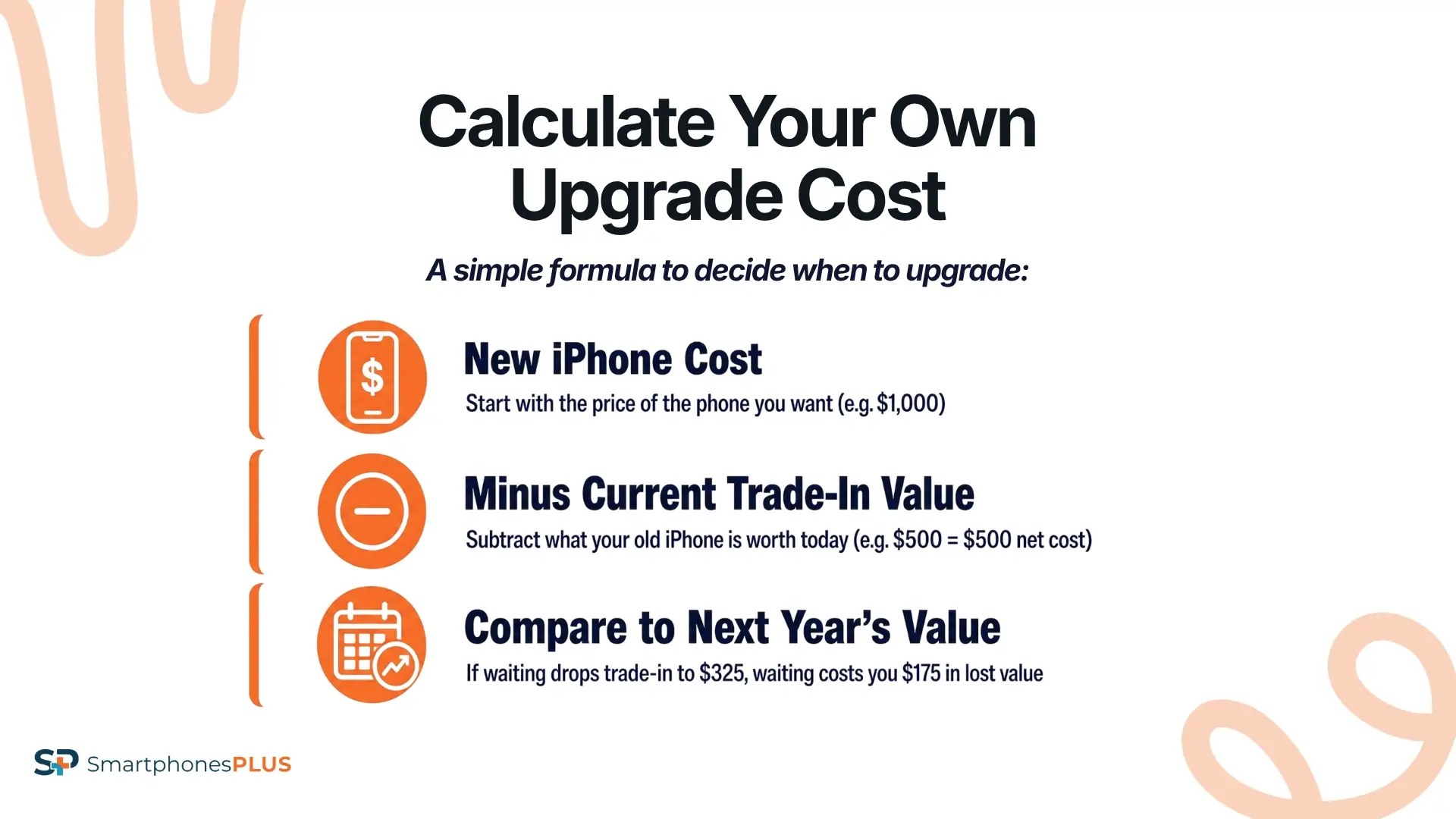
A simple formula can help you decide whether to upgrade now or wait another year.
Start with the cost of the new iPhone you want. Subtract the current trade-in value of your old iPhone. Then compare that number with what you expect your old device to be worth in another year.
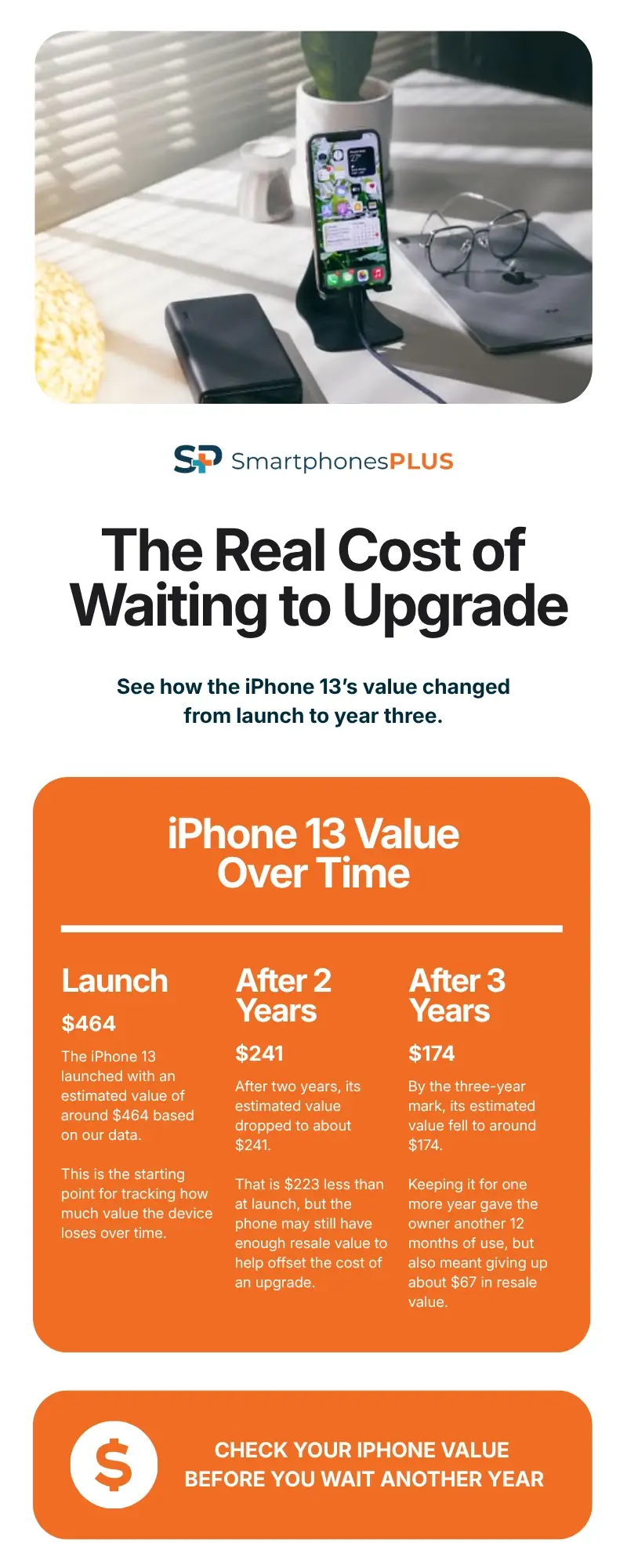
Take the iPhone 13 as an example. Based on our own data, it launched at around $464 and was worth about $241 at the two-year mark and $174 at three years. Waiting through that third year bought another twelve months of use, but it also gave up about $67 in resale value. You can check what your exact device is worth today to see where that tradeoff lands for your model.
That does not automatically mean you should upgrade today. It means the real cost of waiting is measurable, and it grows further with any repair, battery, or condition issue that comes up during that year. Once you see the number, the decision becomes easier. The point is not to upgrade sooner every time, but to recognize when waiting costs more.
When Keeping Your iPhone Longer Still Makes Sense
A two-year upgrade can be financially smart, but it is not the right move for everyone.
Keeping your iPhone longer can make sense if the device is paid off, still performs well, and meets your needs without repair costs. It can also make sense if you are happy with your plan and do not want to spend money on a new device yet.
The key is to avoid letting the phone lose value unnoticed. If you keep it for four or five years, use it with intention. Protect it, maintain it, and understand that the trade-in offer may be much lower by the time you sell.
There is nothing wrong with keeping a phone longer. The mistake is assuming that longer ownership is always the cheapest choice.
Make Your Next Upgrade Pay You Back
The iPhone upgrade cycle is not about buying a new phone as often as possible. It is about knowing when your current phone still has enough value to make the next upgrade easier.
For many owners, the two-year mark is where practical use and strong resale value meet. The phone has done its job, but it has not yet slipped too far down the used-device market. Waiting longer can still work, but the advantage narrows quickly if the phone needs repairs or loses buyer demand.
If your iPhone is paid off, sitting unused, or close to upgrade time, check what it is worth before the next value drop. Get a quote from SmartphonesPLUS today.
FAQs About iPhone Upgrade Timing
Is a two-year iPhone upgrade cycle cheaper?
It can be, depending on the model. Our data shows many mainstream iPhones still hold roughly half their value at the two-year mark, which can offset a large part of the cost of the next phone. It works best when your current iPhone is paid off, in good condition, and still in demand.
How often should I upgrade my iPhone?
Many people upgrade every two to four years. The right timing depends on battery health, condition, software support, repair needs, and how much trade-in value your current phone still has.
Is it better to trade in an iPhone before a new model launches?
Trading in before a major new iPhone release can help protect value because demand for older models may drop after the launch. Values can also fall when more owners start selling the same older models.
Should I replace my iPhone battery before trading it in?
In many cases, no. A battery replacement only makes sense if it raises your offer by more than the repair costs or if you plan to keep using the phone for a long time.
Does keeping an iPhone for five years save money?
It can save money if the phone stays reliable and avoids repairs. The tradeoff is that the resale value may be much lower by the time you finally sell.


