

Your iPhone’s trade-in value doesn’t stay still. A new model announcement, a wave of upgrades hitting the secondhand market, or a shift in buyer demand can move the number fast. The phone in your pocket right now is worth something today that it might not be worth in three months.
“How fast do iPhones depreciate?” is a common question, but it doesn’t have a single answer. iPhone depreciation depends on the model tier, storage size, condition, and age. A Pro Max from last year and a standard model from two years ago follow completely different paths, even if they’re both sitting in a drawer right now.
To get a clear picture of iPhone resale value over time, we looked at live trade-in data from SmartphonesPLUS. By comparing current offers against original retail prices across different generations, we can see exactly how iPhone depreciation works in the real world.
This blog shows which models hold up best and helps you figure out the right time to check your trade-in offer before the market moves again.
The trade-in values in this article are pulled from the SmartphonesPLUS live pricing feed and reflect offers available at the time of writing. Prices update regularly, so your actual offer may differ.
How Quickly Do iPhones Lose Their Value
Value loss starts the moment a new device enters the market. It doesn’t slow down on a predictable schedule. The decline isn’t uniform across every iPhone generation or model tier. Newer premium phones, like the Pro and Pro Max lines, generally follow different resale patterns than standard, mini, Plus, and SE models.
The most useful way to measure iPhone depreciation is to compare the current trade-in value against the original retail price. Applying a single average percentage to every phone gets you the wrong number. A base model iPhone 12 won’t see the same iPhone value drop as a high-capacity iPhone 16 Pro Max.
Recent external market data backs this up. Forbes, reporting on SellCell resale data, noted that five-month iPhone depreciation increased from 24.7% for the iPhone 13 generation to 35.4% for the iPhone 16 generation. That makes tracking individual model data more important than ever.
iPhone Retained Value by Age
How fast do iPhones depreciate? Most lose a large part of their value within the first two years, but some models fall much faster than others.
A Simple Way to Read the Numbers
SmartphonesPLUS used each model’s value at six months as the starting point. Think of that starting value as $1,000. If the phone kept 60% of its value, it would be worth about $600.
If you paid $1,000 for your iPhone, these numbers won’t tell you exactly what you’ll get back. The study tracks trade-in acquisition value, not the price on your Apple receipt. The $1,000 example simply makes the drop easier to picture.
What the Drop Could Look Like
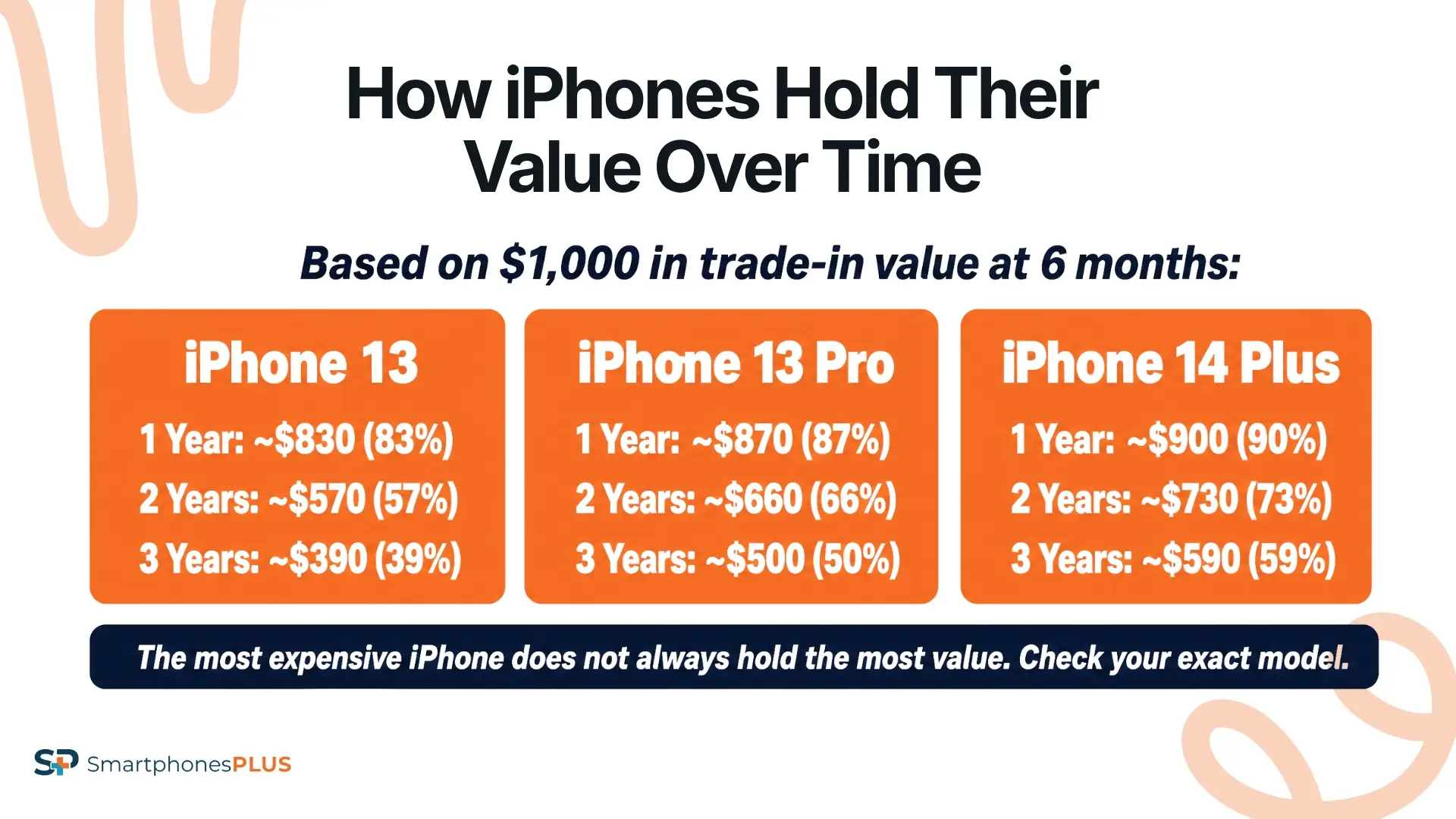
Here’s how a phone worth $1,000 at six months would change based on the data:
- iPhone 13: About $830 after one year (83%), $570 after two years (57%), and $390 after three years (39%).
- iPhone 13 Pro: About $870 after one year (87%), $660 after two years (66%), and $500 after three years (50%).
- iPhone 14 Plus: About $900 after one year (90%), $730 after two years (73%), and $590 after three years (59%).
That’s the iPhone value drop in everyday terms. By the two-year mark, a phone that was worth $1,000 at six months could lose between $270 and $430, depending on the model.
So, how fast do iPhones depreciate? There isn’t one answer for every phone. Checking iPhone resale value over time by model gives you a much better idea of what to expect.
One Thing to Keep in Mind
The SmartphonesPLUS data covers June 2021 through July 2026. It includes website trade-ins, marketplace purchases, and wholesale deals, so these examples are a guide rather than a guaranteed offer.
Which iPhones Hold Their Value Better
The short answer is that Pro models often hold their value well, but they don’t win every time.
Pro Models Can Lose Value More Slowly
At the two-year mark, the iPhone 15 Pro retained about $800 of every $1,000 in six-month value (80%). The regular iPhone 15 retained about $680 (68%). That’s a difference of roughly $120.
Plus Models Can Be a Smart Buy
After two years, the iPhone 14 Plus held onto slightly more of its value than the iPhone 14 Pro Max, even though the Pro Max cost more to start.
After three years, the Plus retained about $590 (59%), while the Pro Max retained about $580 (58%). The two models were nearly tied, despite the Pro Max costing more when it was new.
What This Means for Your Wallet
The most expensive iPhone doesn’t always hold the most value. When you look at iPhone resale value over time, the exact model matters more than the label.
If you’re trying to make your next upgrade more affordable, check your current model’s value instead of assuming a Pro, Plus, or standard iPhone will always come out ahead.
Current iPhone Trade-In Values by Model
The table below pulls live trade-in prices directly from the SmartphonesPLUS pricing feed. Every value shown reflects what you’d get today for an unlocked phone in Good or Broken condition at base storage. These numbers update automatically, so what you see is always current.
These are sample configurations pulled from our live data stream. Your actual offer depends on your exact model, storage, carrier, and condition.
| iPhone model | Configuration | Good condition | Broken condition |
|---|---|---|---|
| iPhone 17 Pro Max | Unlocked, 256GB | $741 | $332 |
| iPhone 17 Pro | Unlocked, 256GB | $696 | $317 |
| iPhone 17 | Unlocked, 256GB | $482 | $146 |
| iPhone 17e | Unlocked, 256GB | $330 | $101 |
| iPhone Air | Unlocked, 256GB | $544 | $165 |
| iPhone 16 Pro Max | Unlocked, 256GB | $524 | $172 |
| iPhone 16 Pro | Unlocked, 128GB | $451 | $177 |
| iPhone 16 Plus | Unlocked, 128GB | $424 | $134 |
| iPhone 16 | Unlocked, 128GB | $380 | $121 |
| iPhone 16e | Unlocked, 128GB | $215 | $79 |
| iPhone 15 Pro Max | Unlocked, 256GB | $415 | $169 |
| iPhone 15 Pro | Unlocked, 128GB | $323 | $132 |
| iPhone 15 Plus | Unlocked, 128GB | $265 | $92 |
| iPhone 15 | Unlocked, 128GB | $261 | $89 |
| iPhone 14 Pro Max | Unlocked, 128GB | $312 | $99 |
| iPhone 14 Pro | Unlocked, 128GB | $258 | $92 |
| iPhone 14 Plus | Unlocked, 128GB | $189 | $70 |
| iPhone 14 | Unlocked, 128GB | $159 | $58 |
| iPhone 13 Pro Max | Unlocked, 128GB | $247 | $85 |
| iPhone 13 Pro | Unlocked, 128GB | $200 | $70 |
| iPhone 13 | Unlocked, 128GB | $140 | $48 |
| iPhone 13 mini | Unlocked, 128GB | $127 | $42 |
| iPhone 12 Pro Max | Unlocked, 128GB | $191 | $66 |
| iPhone 12 Pro | Unlocked, 128GB | $140 | $55 |
| iPhone 12 | Unlocked, 64GB | $94 | $36 |
| iPhone 12 mini | Unlocked, 64GB | $71 | $30 |
| iPhone 11 Pro Max | Unlocked, 64GB | $119 | $42 |
| iPhone 11 Pro | Unlocked, 64GB | $76 | $24 |
| iPhone 11 | Unlocked, 64GB | $69 | $14 |
| iPhone SE 3rd Gen | Unlocked, 64GB | $49 | $7 |
| iPhone SE 2nd Gen | Unlocked, 64GB | $28 | $4 |
When Does an iPhone Lose the Most Value
An iPhone’s value doesn’t drop in a straight, predictable line. It can fall sharply at a few specific points in the ownership cycle. The first iPhone value drop happens right after purchase, simply because the device is no longer new.
The bigger drops tend to come around new model announcements. When Apple reveals a new generation, phone trade-in values drop fast. Upgrade activity floods the secondhand market with older devices, and that extra supply pushes offers down.
New releases don’t hit every model the same way. A previous-generation Pro Max can see a smaller percentage drop than a standard model because demand for its premium specs stays stronger among budget-conscious buyers. The live feed reflects these shifts in real time, adjusting offers based on actual inventory and demand.
What Else Affects iPhone Depreciation
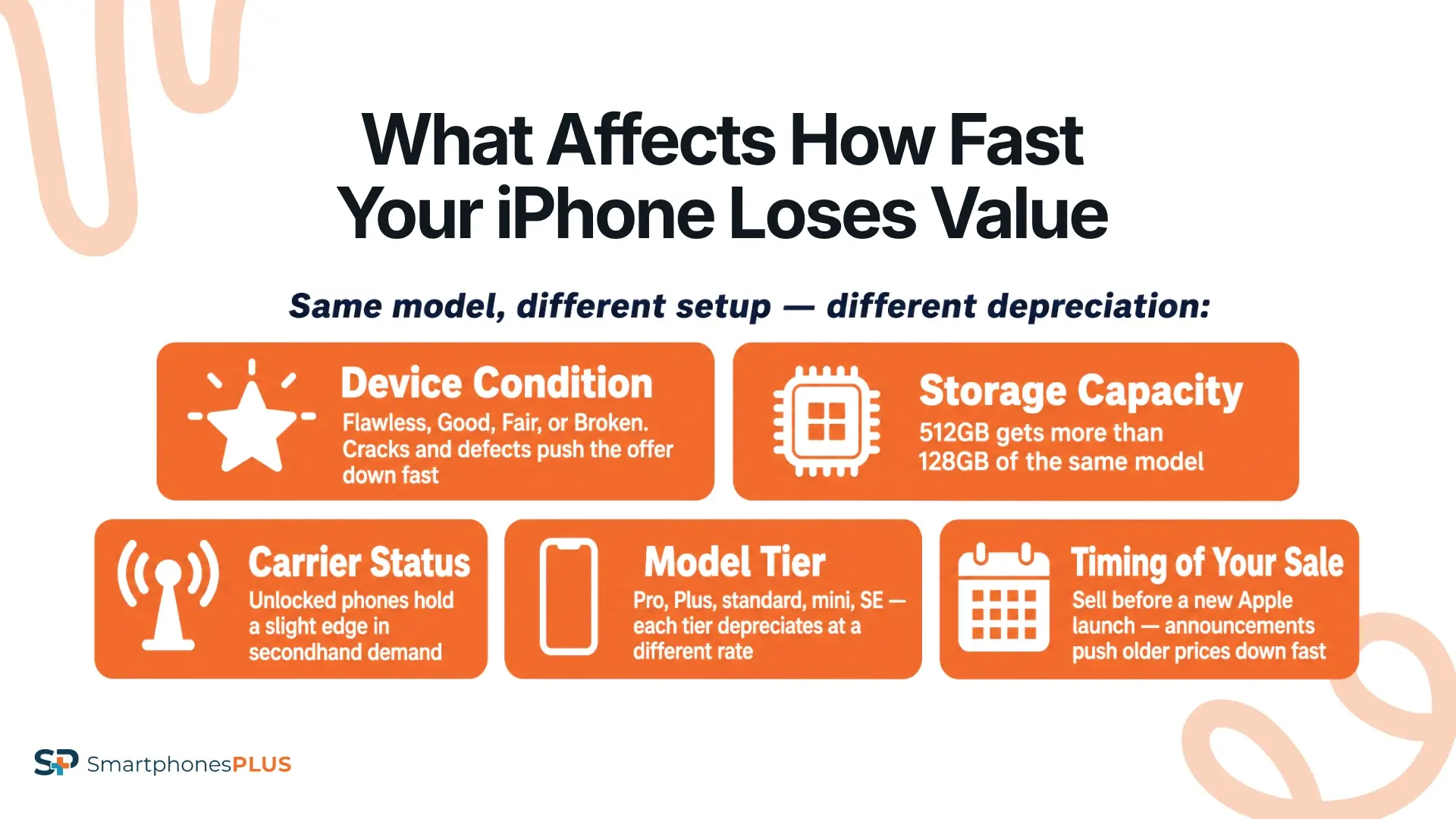
Two versions of the exact same iPhone can lose value at different speeds depending on how they’re configured and cared for.
Condition
The physical and functional state of your phone matters a lot. SmartphonesPLUS categorizes devices as Flawless, Good, Fair, or Broken. Cracks, display defects, camera problems, battery issues, and non-working components all push a phone toward the Broken tier and lower the offer. Damaged devices still carry trade-in value. It’s always worth checking the number instead of assuming a cracked phone is worthless.
Storage capacity
More storage generally means a higher trade-in offer. A 512GB model will get more than a 128GB version of the same phone. The gap is usually smaller than the premium you paid for the extra storage when you bought it, but it’s still a real difference.
Carrier status
Unlocked phones appeal to more buyers because they work with more carriers. Carrier-locked models still sell well, but an unlocked device tends to hold a slight edge in secondhand demand. Only select “unlocked” if that’s actually true for your phone.
Model tier
The tier affects both the original price and how much value sticks around. Standard, Plus, Pro, Pro Max, mini, and SE models from the same year depreciate at different rates. The premium tiers generally show stronger retention over time, as the data above makes clear.
When Should You Sell an iPhone
Knowing when to sell an iPhone is a question that comes up a lot, and the answer is almost always sooner rather than later. If an upgrade is already planned, selling before a major new-model announcement gives you the best chance of locking in a strong offer. Once a new generation drops, older model prices tend to follow.
Holding an unused phone in a drawer while its market value slides is one of the most common ways people leave money behind. Understanding iPhone resale value over time makes the decision easier. The longer you wait past the point of needing the phone, the less you’ll get for it.
Once a device isn’t needed as a backup, selling it quickly means you capture what’s left. The financial case for waiting rarely holds up against the risk of another market-driven price drop.
What to Check Before You Sell
Before deciding what to do with your iPhone, confirm the exact model, storage size, carrier status, and condition. These details explain why two similar phones can receive different offers.
If you decide to send your phone in, sign out of your Apple ID, turn off Find My iPhone, erase your personal data, and make sure any carrier balance has been paid. You can also review how the trade-in process works so you know what to expect before shipping.
Don’t Let an Unused iPhone Keep Losing Value
Your phone’s value depends on more than its age. The model tier, storage, carrier, condition, and timing of your sale all shape what you’ll actually get. Live trade-in data gives you a real number to work with, not an average from months ago.
SmartphonesPLUS lets you check the current value of your exact setup instead of guessing from a static estimate that may already be out of date.
Ready to lock in your offer? Sell your iPhone with SmartphonesPLUS and check your current quote before the next market shift changes the number.
FAQs About iPhone Depreciation
How fast do iPhones depreciate?
The iPhone depreciation rate changes by model, age, storage, and condition. In the SmartphonesPLUS data, the iPhone 13 retained 82.9% of its month-six value at 12 months and 56.9% at 24 months. Other models followed different paths.
Do iPhones lose value when a new model comes out?
Yes. New releases reduce demand for older models and push more used devices into the secondhand market. The size of the iPhone value drop depends on the specific model and how much demand it still carries.
Do Pro iPhones hold their value better?
Some Pro and Pro Max models hold their value better, but that isn’t true in every generation. The iPhone 14 Plus, for example, slightly outperformed the iPhone 14 Pro Max at 24 and 36 months in the historical data.
Is it better to sell an iPhone before or after a new release?
Knowing when to sell an iPhone comes down to timing relative to new launches. Selling before a new release reduces the risk of a market-driven price drop. Once a new model is announced, the influx of trade-ins typically lowers offers on older phones. Checking your value now is a good starting point.
Does a cracked screen speed up iPhone depreciation?
Screen damage lowers the condition-based offer, but it doesn’t mean the phone depreciates faster over time. A cracked iPhone can still have trade-in value. Getting a quote takes a couple of minutes, and it beats assuming the phone isn’t worth selling.


