

iPhone vs Samsung Resale Value: Which Brand Holds Its Value Better?
When you buy a flagship phone, you are making an investment. Whether you spend $799 on a standard model or $1,299 on a top-tier Pro Max or Ultra, that phone represents a significant chunk of money. Eventually, you will want to upgrade, and the amount you get back for your old phone will dictate how much the new one costs you.
The iPhone vs Samsung resale value debate usually starts with the idea that Apple always wins. Others believe Samsung’s trade-in promotions make up for faster depreciation. Looking at the actual numbers gives us a clearer answer.
We used three sources for this phone resale comparison: historical iPhone acquisition data from SmartphonesPLUS, current live offers for both brands, and a 2026 SellCell study comparing the brands after one year. These sources measure different things, so we have kept them separate. The historical iPhone percentages use modeled acquisition value, while the live tables show current cash offers.
The SmartphonesPLUS historical data also includes wholesale and other acquisition channels, so it should be treated as directional rather than a website-only trade-in curve. Together, the numbers provide a clearer look at which phone holds value better over time.
The trade-in values in this article are pulled from the SmartphonesPLUS live pricing feed and reflect offers available at the time of writing. Prices update regularly, so your actual offer may differ.
The 12-Month Mark: The Initial Drop
The first year is the hardest on any phone’s value. The moment you open the box, the device goes from new to used, and the resale value drops immediately. The question is how far it falls.
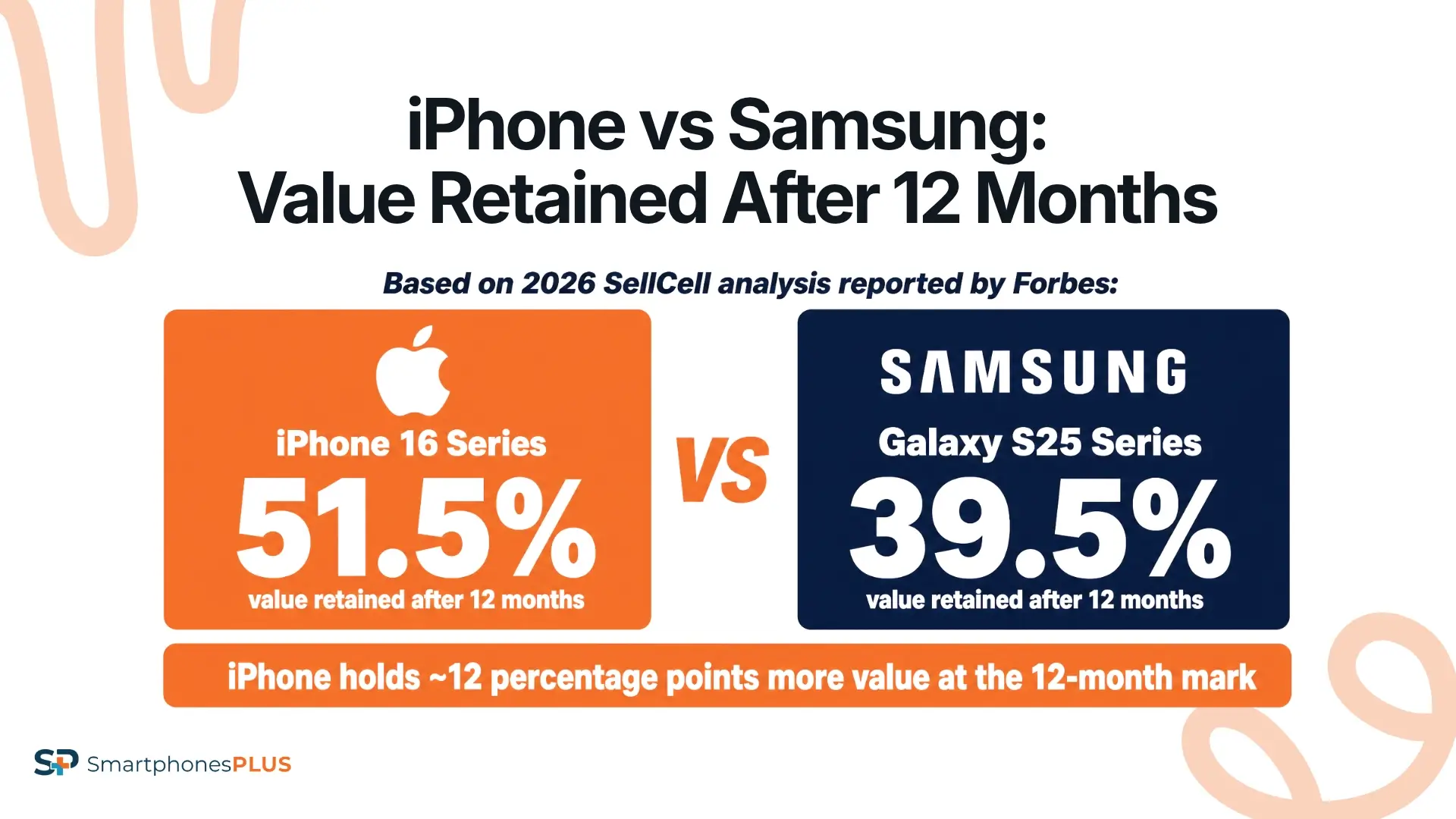
According to a 2026 SellCell analysis reported by Forbes, the iPhone 16 series retained 51.5% of its original value after 12 months. The Samsung Galaxy S25 series retained 39.5%. That gives Apple an early lead in the Samsung vs iPhone trade-in comparison, but the brand average hides some important details.
For a direct 12-month iPhone vs Samsung resale value comparison, the SellCell figures provide the cleanest matchup because both brands were measured at the same age and against their original prices.
SmartphonesPLUS data shows the iPhone 15 Pro Max retaining 90.6% of its modeled launch-period acquisition value after 12 months. That isn’t the same as retaining 90.6% of its retail price. We also don’t have a matching historical Samsung curve from SmartphonesPLUS yet, so a direct Galaxy comparison at this baseline isn’t available. For people who upgrade every year, the matched SellCell data still favors the iPhone.
The 24-Month Mark: The Two-Year Upgrade Cycle
Most people do not upgrade every year. The two-year mark is the most common time to sell, as carrier contracts end and batteries start to show their age. This is where the phone resale comparison gets more nuanced.
Apple’s Two-Year Data and Current Offers
The historical percentages below measure modeled launch-period acquisition value, not original retail price. The live table shows current iPhone 15 offers, so it should be read as a current pricing snapshot rather than a 24-month table.
| iPhone Model | Original Launch Price | Current Offer (Good, Unlocked) |
|---|---|---|
| iPhone 15 Pro Max (256GB) | $1,199 | $415 |
| iPhone 15 Pro (128GB) | $999 | $323 |
| iPhone 15 (128GB) | $799 | $261 |
At 24 months, the historical model shows the iPhone 14 Pro retaining 56.9% of its modeled launch-period acquisition value. The standard iPhone 14 retained 48.6% using the same baseline.
Samsung’s Current-Value Snapshot
The Galaxy S24 table shows current offers rather than an exact 24-month checkpoint. As of July 2026, the lineup is around 30 months old.
| Samsung Model | Original Launch Price | Current Offer (Good, Unlocked) |
|---|---|---|
| Galaxy S24 Ultra (256GB) | $1,299 | $330 |
| Galaxy S24 (128GB) | $799 | $201 |
Based on the live offers, the Galaxy S24 Ultra is currently worth about 25.4% of its original price, while the standard Galaxy S24 is worth about 25.2%. These figures are useful as a current snapshot, but they shouldn’t be compared directly with the modeled 24-month iPhone percentages above.
For the clearest answer to which phone holds value better at the same age, use the matched 12-month SellCell comparison.
The 36-Month Mark and Beyond
SmartphonesPLUS historical data shows the iPhone 13 Pro retaining 45.7% of its modeled launch-period acquisition value at 36 months. The standard iPhone 13 retained 37.4% using the same baseline.
The current Galaxy S23 offers don’t provide a matching comparison. Those phones are now around 41 months old, and comparing their current offers with retail MSRP uses a different age and baseline from the iPhone data.
The available numbers show that both brands lose a large share of their value over three or four years. The exact Samsung vs iPhone trade-in difference at 36 months can’t be calculated from the supplied data alone.
Why iPhone vs Samsung Resale Value Can Differ
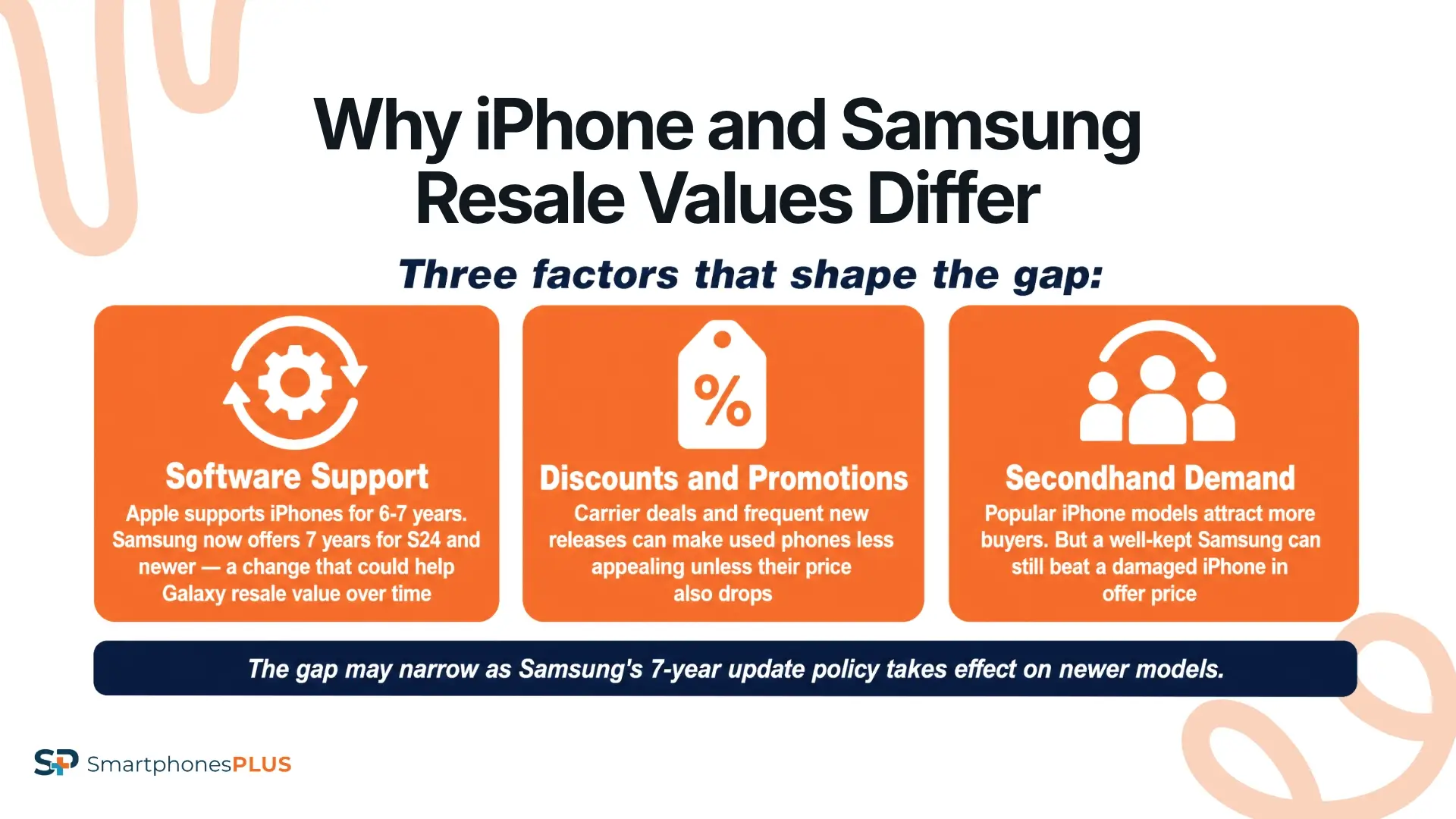
The available phone resale comparison shows a gap between the brands, but it doesn’t prove that one factor causes the entire difference. Several things may affect resale demand.
Software Support
Older phones are easier to resell when they still receive security and operating-system updates. Samsung now provides seven years of updates for the Galaxy S24 and newer flagship models. This brings its support window closer to the long useful life many iPhones receive.
That change could help newer Galaxy phones remain useful for longer, but it’s too early to know exactly how much it will change their resale prices.
Discounts and New Releases
Discounts, carrier promotions, and frequent product releases can affect what buyers will pay for a used phone. A new-phone discount may make a used device less appealing unless its price also falls.
These patterns vary by model and year. The supplied data doesn’t measure how much each factor contributes to depreciation.
Secondhand Demand
Demand also changes across specific models, storage sizes, and conditions. A popular iPhone may have more buyers than a less common Galaxy model, but a well-kept Samsung can still receive a stronger offer than a damaged iPhone.
What This Means for Your Next Purchase
The cleanest answer to which phone holds value better comes from the matched 12-month study, which favors the iPhone. SmartphonesPLUS historical data also shows how iPhone acquisition values change over time, while the live tables show what specific iPhone and Samsung models are worth now.
These sources don’t prove the exact brand gap at 24 and 36 months because they use different ages and baselines. The iPhone vs Samsung resale value evidence still points toward Apple holding value better overall, but the size of that advantage depends on the model and when you sell.
A phone resale comparison is only one part of the buying decision. Samsung promotions may reduce the upfront cost of upgrading, while a higher iPhone cash value may give you more flexibility when you sell independently. We covered how phone trade-in values drop over time in a previous post, and the timing of your sale matters for both brands.
Compare Your Phone’s Current Value
The available data points toward iPhones holding more value in a matched 12-month comparison. Your actual offer still depends on the model, storage, carrier, and condition.
The live SmartphonesPLUS tables give you a starting point. You can then enter the details of your phone to receive a quote for that specific device.
If you want to see where your phone sits in the Samsung vs iPhone trade-in comparison, check its current offer at SmartphonesPLUS and decide whether selling or keeping it makes more sense for you.
FAQs About iPhone vs Samsung Resale Value
Which Phone Holds Value Better, iPhone or Samsung?
The matched 12-month SellCell study shows the iPhone retaining more value than the comparable Samsung lineup. The supplied SmartphonesPLUS data doesn’t provide matched Samsung figures at 24 and 36 months, so we can’t calculate the exact gap at those points.
Why Do Samsung Phones Depreciate Faster Than iPhones?
Several factors may contribute, including buyer demand, discounts, the number of available models, and software support. The pricing data shows the difference in value, but it doesn’t measure exactly how much each factor causes.
Does Storage Size Affect iPhone vs Samsung Resale Value?
Yes. Higher storage capacities increase the trade-in value for both brands. The extra money you get back when you sell is rarely equal to the premium you paid for the storage upgrade when the phone was new. The base storage model often retains the highest percentage of its original price for both iPhone and Samsung.
Is the Samsung vs iPhone Trade In Gap Closing?
It might be. Samsung now provides seven years of updates for newer flagship models, bringing its support window closer to the useful life buyers expect from an iPhone. That could help newer Galaxy phones hold value longer, but there isn’t enough long-term data yet to confirm the size of the change.
Should I Sell My Phone Online or Trade It In?
Selling your phone online to a buyback company typically gets you a cash payment, which you can use for anything. Trading in with a carrier usually gets you bill credits spread over 24 to 36 months, tying you to that carrier. If you want the flexibility of cash, selling online is usually the better option for both iPhone and Samsung devices.


