
Most people stop thinking about their old phone’s value after they upgrade. It gets placed in a drawer as a backup, then sits there for months or even years. The phone still works, so it feels like it has value. But the market doesn’t care whether the phone is powered on or sitting in a box.
Keeping a backup phone can be useful. But if you don’t plan to use it, knowing how phone value changes over time can help you decide what to do with it. The numbers are more concrete than most people expect.
SmartphonesPLUS used iPhone acquisition data from June 2021 through July 2026 to estimate phone depreciation by month. Each model’s value at six months was used as the starting point, then the data tracked the average percentage lost each month.
The data includes website trade-ins and business and school bulk trade-ins. It shows the overall direction of acquisition values, not a guaranteed website offer. Understanding phone depreciation by month is the clearest way to put a real number on what keeping an unused device actually costs.
What Phone Depreciation by Month Looks Like
The monthly rate is the average percentage of value a model loses as it gets older. It’s the clearest way to answer “how much does a phone lose value per month?”
The $1,000 example shows what the first month’s loss could look like if the phone were worth $1,000 at the six-month starting point.
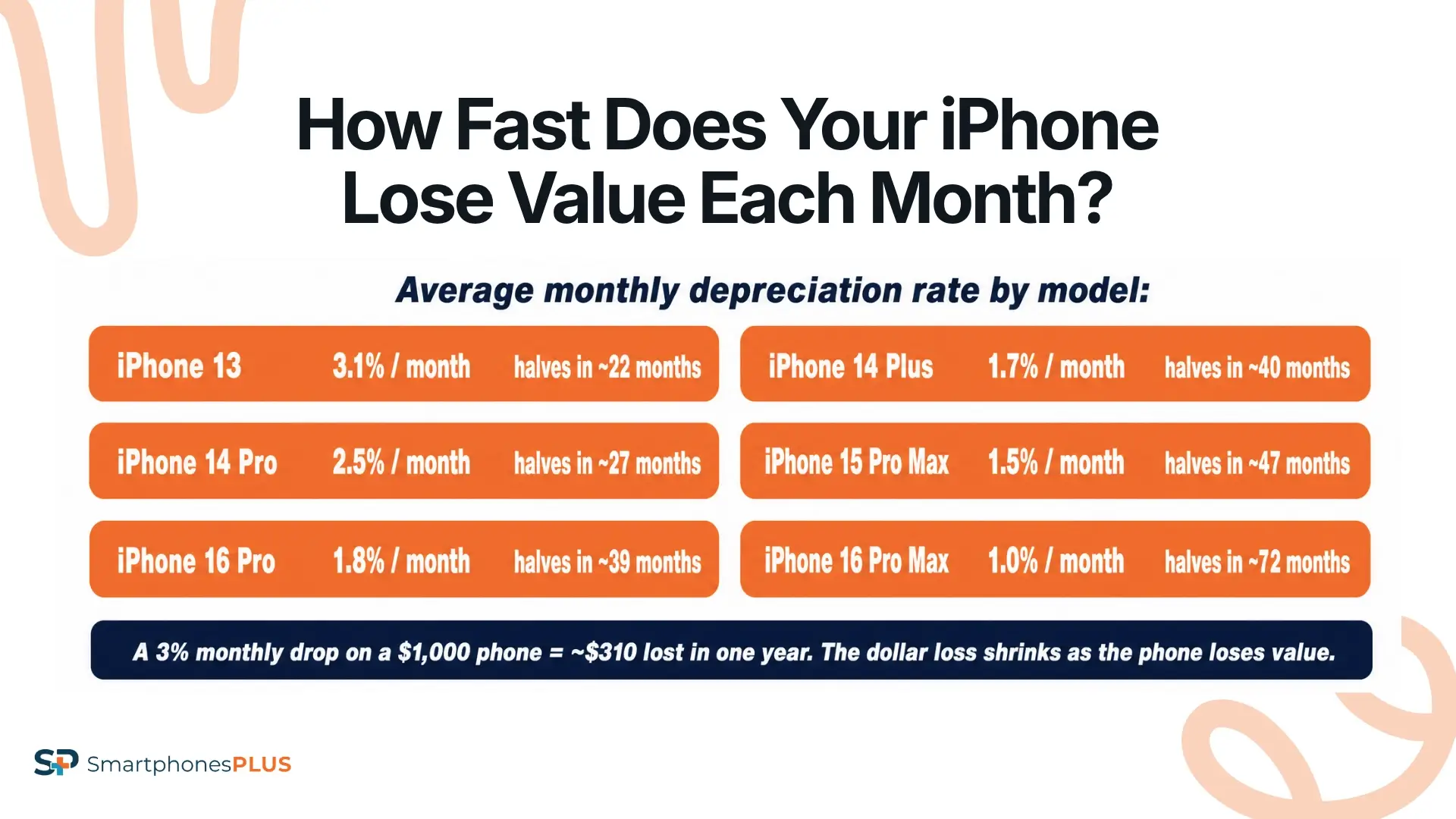
| iPhone Model | Average Monthly Drop | First-Month Loss From $1,000 | Value Halves In |
|---|---|---|---|
| iPhone 13 | 3.1% | About $31 | About 22 months |
| iPhone 13 Pro | 2.3% | About $23 | About 30 months |
| iPhone 13 Pro Max | 2.9% | About $29 | About 23 months |
| iPhone 14 | 2.9% | About $29 | About 24 months |
| iPhone 14 Plus | 1.7% | About $17 | About 40 months |
| iPhone 14 Pro | 2.5% | About $25 | About 27 months |
| iPhone 15 Pro Max* | 1.5% | About $15 | About 47 months |
| iPhone 16 Pro* | 1.8% | About $18 | About 39 months |
| iPhone 16 Pro Max* | 1.0% | About $10 | About 72 months |
| iPhone SE (3rd Gen) | 2.9% | About $29 | About 24 months |
The dollar loss gets smaller as the phone’s value falls. A 3% drop on $1,000 is $30, but a 3% drop on $500 is only $15. That’s why the table doesn’t treat depreciation as the same dollar amount every month.
The iPhone 15 and 16 models have less historical data, so their long-term estimates may change as more information becomes available.
What the Monthly Numbers Mean
A monthly percentage may look small, but it adds up over time.
A Faster-Losing Model
The iPhone 13 lost about 3.1% of its value each month. If it were worth $1,000 at the six-month point, it would be worth around $690 one year later. That is a $310 drop in twelve months, or roughly $26 per month in real dollar terms. For a phone that originally cost $799, that is a significant chunk of the original purchase price.
A Slower-Losing Model
The iPhone 16 Pro Max lost about 1% per month in the available data. Using the same example, a $1,000 value would fall to about $890 after another year. That is a much slower decline than the iPhone 13, which reflects the strong secondhand demand for recent Pro Max models.
That estimate is based on a shorter history, so it may change as the phone gets older. The iPhone 15 Pro Max showed unusually strong retention in the data, and the 16 Pro Max appears to be tracking a similar pattern so far.
What Half-Life Means
Half-life is the amount of time it takes a phone to lose half of its six-month value. The iPhone 13 reached that point in about 22 months. The iPhone 14 Plus took around 40 months.
If you’re deciding when to sell phone hardware, half-life gives you a simple way to compare how quickly different models are losing value. It also shows why phone depreciation by month needs to be checked by model, not assumed to be the same across the lineup. A phone that takes 40 months to halve in value gives you a very different selling window than one that hits that point in 22 months.
What Can Make the Value Drop Faster
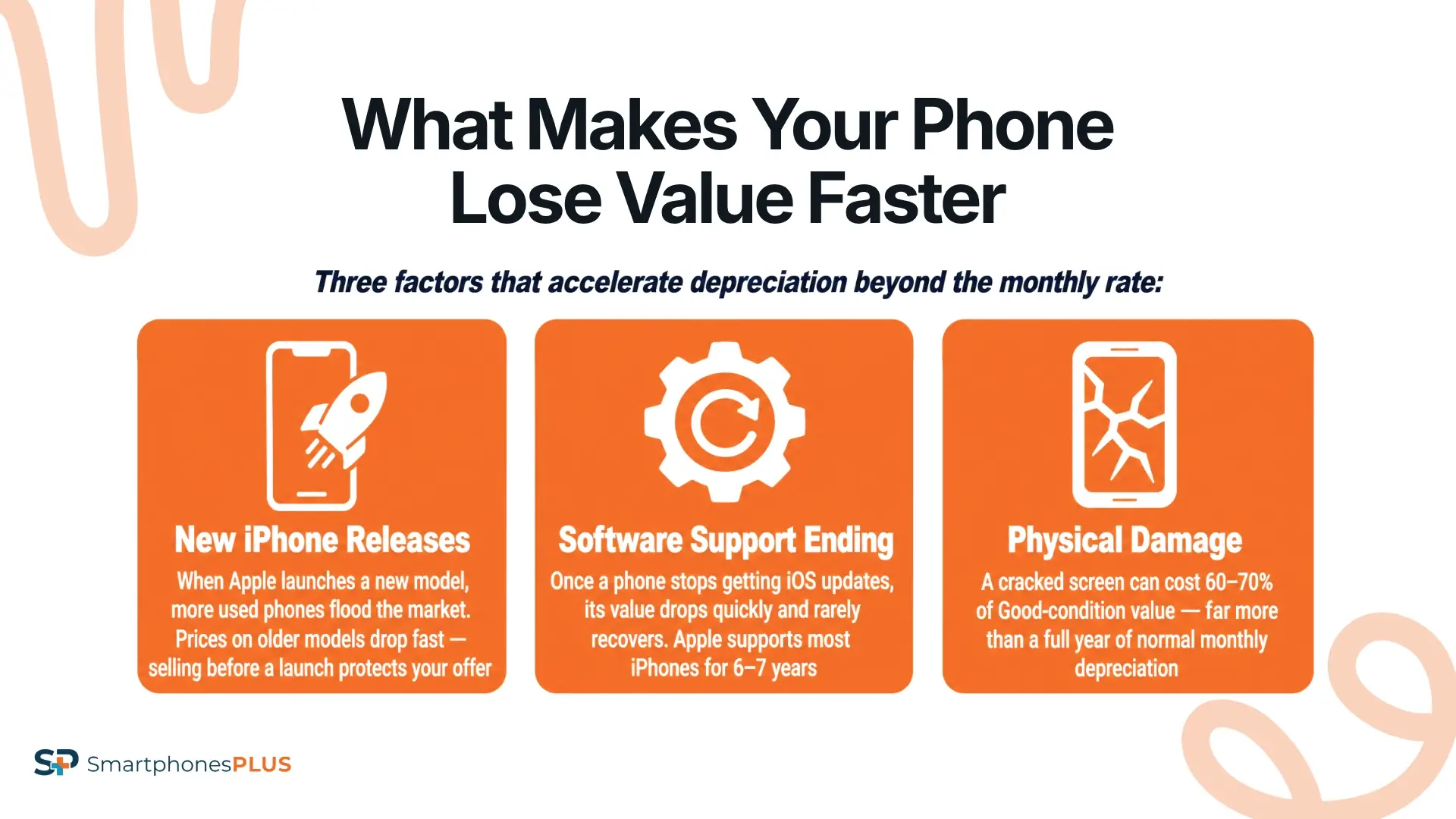
The monthly rates show the general pattern, but real offers can also change when the market shifts or the phone is damaged.
New iPhone Releases
Trade-in prices can change when Apple releases a new generation. More people start selling their older phones at the same time, which gives used buyers more choices and puts downward pressure on prices.
If you’re searching “when to sell phone,” checking your offer before a major launch can give you a useful point of comparison. There isn’t one month that guarantees the highest price, but the weeks immediately after a new launch tend to be the worst time to sell an older model. We covered how phone trade-in values drop over time in a previous post, and the pattern around new launches is worth understanding before you decide.
Software Support
Older phones may become less appealing when they stop receiving current software and security updates. Support lasts for years, but the exact timeline depends on the model. Apple typically supports its phones with iOS updates for six to seven years, so most devices have a long runway before this becomes a factor. Once a phone drops off the update list, though, the value tends to fall quickly and doesn’t recover.
Physical Damage
A cracked screen can make a much larger difference than one month of normal depreciation. As we covered in our breakdown of cracked screen phone value, SmartphonesPLUS typically sees cracked iPhones lose around 60% to 70% of their Good-condition value.
That drop comes from the phone moving into a lower condition tier. It isn’t the same as normal monthly depreciation, but it has a far bigger immediate impact on what you’ll get back. A single accident can cost you more than a full year of normal phone depreciation by month.
What Waiting Could Cost
How much does phone lose value per month? It depends on both the monthly rate and what the phone is worth now.
For example, an iPhone losing 1.8% per month would fall from $1,000 to about $900 after six months. After one year, it would be worth around $800.
The same rate would create a smaller dollar loss on a cheaper phone. If the starting value were $500, the loss after one year would be closer to $100.
That doesn’t mean everyone should sell immediately. A backup phone may still be useful. But if you’re asking “how much does phone lose value per month?” because the device is sitting unused, checking its current price can help you decide if keeping it is worth the cost.
There’s no perfect formula for how fast a phone loses value. Ingram Micro Lifecycle says new releases, age, condition, supply, and demand can all affect the price. The monthly rates above are a useful guide, but your exact offer can still change.
Help Your Phone Hold Its Value
A protective case and screen protector can help prevent the damage that causes the largest price drops. Keeping the phone paid off and removing carrier or account locks can also make it easier to sell.
Phone value over time still falls as the model gets older, even when the device is in good condition. If you’re wondering when to sell phone hardware, start by deciding if you still need it as a backup.
If you’re using it, keeping it may make sense. If it has been sitting untouched for months, checking the current offer will show you what waiting may cost. The phone value over time data makes that cost concrete rather than abstract, which makes the decision a lot easier to make.
See What Your Phone Is Worth Now
Phone depreciation by month can help you understand the larger pattern, but your current offer will still depend on the model, storage, carrier, and condition.
SmartphonesPLUS uses those details to give you a price based on your specific phone. You can review that number before deciding if you’re ready to sell. The process is quick, the shipping is covered with a free prepaid label, and you get paid in cash rather than store credit.
Check what your unused phone is worth today, then choose the option that makes the most sense for your budget. Head to SmartphonesPLUS to see your real cash offer.
FAQs About Phone Depreciation
How much does a phone lose value per month on average?
It depends on the model. The phones in this analysis lost about 1% to 3.1% of their value per month. Because depreciation compounds, the dollar amount lost becomes smaller as the phone’s value falls.
When should you sell phone hardware for the best price?
There isn’t one month that guarantees the best price. Checking before a new model launches may help you compare your options before more used phones enter the market.
Does phone value over time drop in a straight line?
No. The historical model uses a smooth monthly average, but real trade-in prices can also change because of new releases, demand, condition, and available inventory.
Is it worth keeping an old phone as a backup?
It can be if you expect to use it. If the phone has been sitting untouched for months, compare its current value with how useful it would actually be as a backup.
What accelerates phone depreciation by month the most?
Physical damage can cause a much larger immediate drop than normal monthly depreciation. Model age, software support, demand, carrier status, and condition can also affect the offer.


