

When your smartphone slips from your hand and shatters on the pavement, the immediate feeling of dread is universal. The next thought is usually a frantic calculation: is it cheaper to repair or replace a phone? It is a question that millions of consumers face every year, and the answer is rarely straightforward.
With the rising cost of flagship devices and the increasing complexity of repairs, making the right financial decision requires more than a quick guess.
Many people assume that repairing a broken screen or a dying battery is always the most economical choice. However, this assumption ignores the hidden costs of holding onto an aging device. As smartphones get older, their trade-in value drops significantly, and the likelihood of needing additional repairs increases.
To truly understand if it is cheaper to repair or replace a phone, you need to look at the complete financial picture.
In this guide, we will break down the true costs of smartphone ownership and provide a clear framework for making this decision. We will introduce a simple cost-benefit formula that takes the guesswork out of the equation. By the end of this article, you will have the tools you need to confidently decide whether to fix your current device or trade it in for something new.
The Rising Cost of Smartphone Repairs
To understand the repair vs. replace dilemma, we first need to look at the current state of the repair industry. According to a survey by SquareTrade, Americans spent an estimated $3.4 billion replacing millions of smartphone screens in a single year.
This staggering figure highlights how common and expensive smartphone damage has become.
Modern smartphones are marvels of engineering, packed with high-resolution OLED displays, advanced camera systems, and intricate internal components. While this technology provides an incredible user experience, it also makes repairs significantly more difficult and costly. A simple screen replacement on a flagship device can easily cost between $200 and $400, depending on the model and the repair shop.
Battery replacements are generally more affordable, typically ranging from $50 to $100. However, if your phone has suffered water damage or requires a motherboard repair, the costs can quickly escalate beyond the value of the device itself. When evaluating if it is cheaper to repair or replace a phone, you must start by getting an accurate estimate for the specific repair you need.
The Hidden Costs of Holding On

While the upfront cost of a repair is easy to quantify, the hidden costs of keeping an older phone are often overlooked. The most significant of these hidden costs is depreciation. Smartphones lose value rapidly, with many models losing more than half their trade-in value within the first year.
Every month you hold onto a damaged or aging phone, its trade-in value decreases. Repairing it can make sense in some cases, but it is worth comparing the repair cost against the phone’s remaining value. For example, if your phone is worth about $300 today and the repair costs $250, you would have $550 tied up in a device that may only be worth $150 a year from now. A new phone will depreciate too, but the key question is whether putting more money into the older phone gives you enough extra use to justify the cost.
Furthermore, older phones are more likely to experience performance issues, software incompatibilities, and battery degradation. These factors can lead to a frustrating user experience and may eventually force you to upgrade anyway. When considering if it is cheaper to repair or replace a phone, you must factor in the inevitable decline in your device’s value and performance.
The Fix vs. Trade-In Calculator Formula
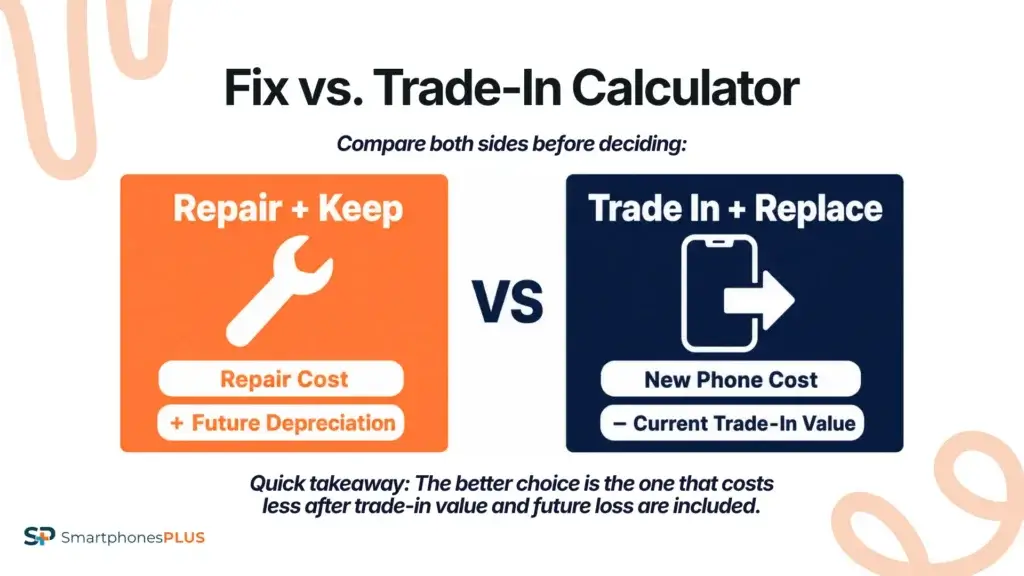
To make a truly informed decision, you need a reliable way to compare the costs and benefits of both options. We have developed a simple cost-benefit formula that takes the emotion out of the process and provides a clear financial answer.
Here is the formula to determine if is it cheaper to repair or replace a phone:
Repair Cost + Future Depreciation vs. Current Trade-In Value (As-Is) + Cost of New Device
Let’s break down how to use this formula step-by-step:
- Determine the Repair Cost: Get a quote from a reputable repair shop for the necessary fixes.
- Estimate Future Depreciation: Research how much your phone’s value is likely to drop over the next year.
- Find the Current Trade-In Value (As-Is): Check how much a buyback company will pay for your phone in its current, damaged condition.
- Determine the Cost of a New Device: Decide which phone you want to buy and find its current retail price.
By comparing the total cost of repairing and keeping your phone against the net cost of trading it in and upgrading, you can clearly see which option makes the most financial sense.
When is it Cheaper to Repair or Replace a Phone?
Let’s apply the formula to a common scenario. Imagine you have a two-year-old flagship phone with a shattered screen.
- Repair Cost: $350
- Estimated Future Depreciation (1 Year): $200
- Current Trade-In Value (Damaged): $175
- Cost of New Device: $800
Option 1 (Repair and Keep): Total Cost = Repair Cost ($350) + Future Depreciation ($200) = $550
Option 2 (Trade-In and Replace): Net Cost = Cost of New Device ($800) – Current Trade-In Value ($175) = $625
In this specific example, repairing the phone is still cheaper in the short term. However, the gap is narrower than it might initially appear. If the repair cost were higher, or if the phone were older and depreciating faster, the math could easily flip in favor of replacing it.
This is why it is crucial to run the numbers for your specific situation. The answer to whether it is cheaper to repair or replace a phone depends entirely on the variables involved.
When Repairing Makes Sense
Despite the hidden costs of depreciation, there are many situations where repairing your phone is the smartest financial move.
If your phone is relatively new (less than a year old) and the repair cost is low (such as a simple battery replacement), fixing it is almost always the best option. The device still has a long useful life ahead of it, and the repair cost is a small fraction of its overall value.
Repairing also makes sense if you are perfectly happy with your current phone’s performance and features. If you don’t need the latest camera technology or the fastest processor, spending a few hundred dollars to extend the life of your current device can save you a significant amount of money compared to buying a new flagship.
Finally, if you are on a tight budget and cannot afford the upfront cost of a new phone, repairing your current device may be your only viable option. In these cases, finding a reputable, affordable repair shop is the priority.
When Replacing is the Better Option

On the other hand, there are clear indicators that it is time to let go of your damaged device and upgrade to something new.
If the cost of the repair exceeds 50% of the phone’s current resale value (in good condition), it is generally not worth fixing. You are pouring money into a depreciating asset that will likely need to be replaced soon anyway.
Replacing is also the better option if your phone is more than three years old. At this point, the device is likely no longer receiving software updates, and its internal components are nearing the end of their lifespan. Even if you fix the immediate problem, you are likely to encounter other issues in the near future.
If your phone has suffered severe damage, such as being submerged in water or run over by a car, the repair costs will likely be astronomical. In these cases, the decision is easy: trade in the damaged device for whatever value you can get and put that money toward a replacement.
The Carrier Trade-In Trap
When you decide to replace your phone, you will likely be bombarded with trade-in offers from your carrier. While these offers can seem tempting, they often come with significant strings attached.
As we discussed in our article on carrier trade-in vs selling for cash, carrier promotions are designed to lock you into long-term contracts and expensive unlimited data plans. The advertised trade-in value is usually paid out in monthly bill credits over two or three years.
If you are trying to figure out if it is cheaper to repair or replace a phone, you need to factor in the true cost of these carrier deals. The extra money you spend on a premium data plan over a 36-month contract can easily wipe out any perceived savings from the trade-in promotion.
The Smart Way to Trade In
If you have run the numbers and decided that replacing your phone is the best option, the smartest way to maximize your return is to sell your damaged device to an online buyback company.
Unlike carriers, buyback companies offer straightforward cash payments for your device, regardless of its condition. You don’t have to sign a contract, and you don’t have to upgrade to a more expensive plan. You simply get a fair market price for your phone, which you can then use to purchase a new device outright or put toward any other expense.
Even if your phone has a cracked screen or a dead battery, it still has value. Buyback companies specialize in refurbishing and recycling electronics, so they are willing to pay for devices that carriers might reject or undervalue. Our guide on top buyback sites that actually pay well for used electronics can help you identify the best options for your specific device.
Making Your Final Decision
Deciding whether to repair or replace a damaged smartphone is a personal choice that depends on your financial situation, your device’s age, and your tolerance for risk. By using the cost-benefit formula outlined in this guide, you can make an informed decision based on facts rather than assumptions.
Remember to consider the hidden costs of depreciation and the long-term commitments associated with carrier trade-in deals. Our article on how phone trade-in values drop over time provides a detailed breakdown of how quickly your device loses value each month. When you look at the complete financial picture, the answer to whether it is cheaper to repair or replace a phone becomes much clearer.
If you decide that upgrading is the right move, don’t let your damaged phone sit in a drawer gathering dust. Turn it into cash and offset the cost of your new device.
Trade In Your Damaged Phone Today
Ready to upgrade? Don’t let a cracked screen or a dying battery hold you back. Get a fair, upfront cash offer for your damaged device today.
Trade in your phone with SmartphonesPLUS and use the cash to buy the replacement you really want.
FAQs About Repairing vs. Replacing Phones
Is it worth fixing a cracked phone screen?
It depends on the age and value of the phone. If the repair cost is less than half the phone’s current value and you plan to keep it for at least another year, it is usually worth fixing.
How much does it cost to replace a phone battery?
Battery replacements are generally affordable, typically ranging from $70 to $120 depending on the model and the repair shop. This is often a worthwhile investment to extend the life of an older phone.
Will a carrier accept a damaged phone for trade-in?
Some carriers accept damaged phones, but they often require you to sign up for an expensive premium plan and pay you in monthly bill credits. Selling to a buyback company is usually a better option for damaged devices.
How long should a smartphone last?
With proper care, a modern smartphone should last between three and five years. However, battery degradation and software obsolescence often prompt users to upgrade sooner.
What should I do with a phone that is too expensive to fix?
If a phone is too expensive to fix, you should sell it to an online buyback company. Even severely damaged phones have salvageable parts and can be sold for cash.


